

One-State, Two-State...
In the Midst of a Genocide, Dreaming of an “After”

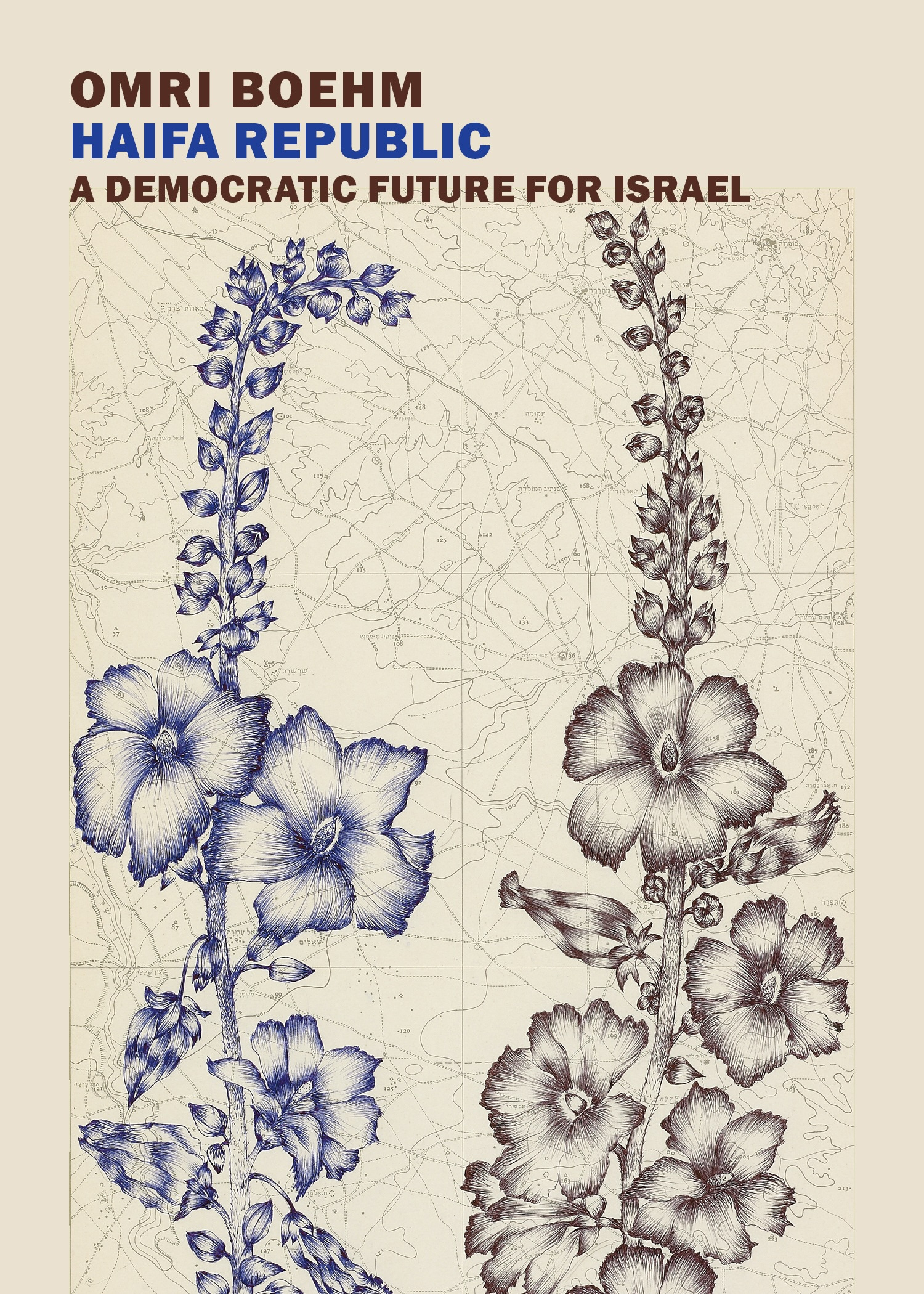
Bridging past, present, and future, Omri Boehm’s Haifa Republic: A Democratic Future for Israel (New York Review Books) remains timely despite having been published nearly four years ago. The grim reason: however keen Israel’s supporters have been to cast the Hamas attacks of October 7, 2023, as a great historical rupture, Boehm’s book demonstrates the continuities. The startling realization that Bezalel Smotrich, Israel’s current minister of finance, said in 2019, “As far as I am concerned, let Gaza rot, let them die of hunger, of thirst, and of malaria,” clarifies how we arrived at the present horrible moment. Smotrich at the time also pitched “massive emigration” from the territory—“otherwise known in Israel as ‘voluntary transfer,’ ” as Boehm says (7). In its historical perspective, Boehm’s book shows how population transfer, not at all “voluntary,” has been a cornerstone of Zionist state building since the Peel Commission floated the idea in 1937 and Zionist militias began implementing it in earnest in 1948.
Though Boehm, a professor of philosophy at the New School, has much to say about this history of displacement and exclusion, his main concern, as the subtitle indicates, is the future. Starting with a précis of the two-state solution, still an ideological lifeline for liberal Zionists in the United States,1 he ends with a blueprint for a “federal, binational republic” (11), “a joint sovereign state” (12) with two autonomous entities under its aegis, one for Jews and one for Palestinians—dubbed the Haifa Republic, because its seat would be the city where it is possible to “glimpse…what Palestinian-Jewish cohabitation could one day look like” (164). Boehm seeks to validate his binational vision to Zionist readers by pointing to a plan once floated by none other than Menachem Begin, in the throes of negotiating the peace deal with Egypt, a plan that passed the Knesset “by a large majority in December 1977” (19), only to slip into oblivion when the Israelis realized they could cut a deal without conceding anything to Palestinians (150).
The nod to Begin is central to Boehm’s self-positioning. Since Boehm’s Haifa Republic is defined by equal rights and citizenship for all the people living within its borders, under a unified political structure, it might be classified as anti-Zionist. But Boehm, like Shaul Magid in The Necessity of Exile (previously reviewed here), reserves that term for those on his political left, casting himself as advocating “a truly liberal Zionism” (14) and arguing that “the vital center,” as he calls it, “can still be reclaimed” (11). The “Jewish self-determination in a binational republic” (14) that he proposes is genuinely Zionist, Boehm stresses—and if you don’t believe him, he says, look not just at Begin’s proposal but at the binationalism once countenanced by David Ben-Gurion, Ze’ev Jabotinsky (the ideological forefather of today’s Likud), and even Theodor Herzl himself (48–56).
The startling realization that Bezalel Smotrich, Israel’s current minister of finance, said in 2019, “As far as I am concerned, let Gaza rot, let them die of hunger, of thirst, and of malaria,” clarifies how we arrived at the present horrible moment.
The surprising history and quotations that Boehm assembles in his discussion do have an explanation: Zionism’s founders espoused and pursued modest aims in the early stages, when their horizon of possibility was relatively limited. In that respect, the Herzl quotation that provides the book with its epigraph—“If you will it, it is no dream”—is layered with irony. Just as the foundation of the state of Israel must have seemed highly unlikely from the perspective of the late nineteenth century, Boehm implies, his vision of a binational federation, equally unlikely from the perspective of the present, might be achievable. Yet from the vantage point of 2025, Herzl’s plan, expressed in 1895, sounds less than dreamy, as it involves “expropriat[ing] gently the private property on the estates assigned to us”; “spirit[ing] the penniless population across the border by procuring employment for it in the transit countries, while denying it any employment in our country”; and “expropriat[ng] and…remov[ing]…the poor…discreetly and circumspectly.”2
To posit a purer form of Zionism that somehow became corrupted along the way, then, is delusive, and in that sense, Boehm’s historical perspective is not altogether different from that of Amos Oz, a liberal whitewasher of atrocities (116–17), as it turns out, and someone whom Boehm sharply criticizes. Quoting Ben-Gurion’s disavowal during World War I of any intent “to push the Arabs aside, to take their land, or to disinherit them,” Boehm wants to believe that Ben-Gurion “wrote…in earnest” (99), even if “a change of tone came almost instantly after the Peel Commission suggested…partition[ing] Palestine” and “moving Palestinians” (100). At that point, Ben-Gurion exulted in the thought that “the compulsory transfer…could give us…an opportunity that we never dared to dream of in our wildest imaginings” (100). Whereas Oz traced the corruption of Zionism back to the Occupation (starting in 1967), Boehm sees it in the Nakba (111) and its antecedents, but each of them soft-pedals or elides the settler colonial ethos that was there from the beginning.
All the same, Boehm’s assessment of present-day Zionism is withering. Noting that since 1993, the time of the Oslo Agreement, the number of settlers living beyond the Green Line has risen from “approximately 260,000…to about 700,000,” he says, “we should talk of apartheid instead of occupation, for the territory has already de facto been annexed.” Though “apologists for Israel denounce the use of the word ‘apartheid’ as an effort to ‘delegitimize’ the country’s existence,” Boehm says, “the country’s true friends should insist on it, too” (139).
As Boehm makes clear, no matter how many Palestinian doctors and judges one might point to in Israel proper,3 there remain two tiers of citizenship even there, reflected, for example, in “a…program called Judaizing the Galilee” (40), which “enabled the government to confiscate the land of Arab Israelis, check the natural growth of their villages, and disrupt territorial continuity between Arab Israeli towns” through the construction of “communal villages” that “Arabs are officially not allowed” to live in (40). In politics, though Palestinians constitute 22 percent of the citizen body and can vote, their elected representatives must adhere to Clause 7A of Basic Law: The Knesset, an amendment added in 1985 that bans any candidates whose “aims or actions, expressly or by implication, point to…denial of the existence of the State of Israel as the state of the Jewish people” (41). Accordingly, when “the Joint List, a parliamentary alliance consisting mostly of Arab Israeli members of the Knesset,” proposed “Basic Law: The State of All Its Citizens,” it was never debated or voted on, “but ban[ned] altogether” (43). Meanwhile, in the school system, Jewish and Palestinian children are separated because, as Boehm puts it:
if they studied together, [they] would quickly fall in love. Within one generation, they would have children of their own. And indeed, how could a Jewish state handle the mixed sons and daughters of a humanistic education system? Would the Supreme Court approve their designation as Israeli rather than Jewish or Arab? (46–47)
As Boehm points out earlier in the chapter, the Israeli Supreme Court absurdly ruled in 2013 against recognition of an “Israeli” identity, finding that “claimants who had asked to be labeled ‘Israeli’ rather than ‘Jewish’ on their personal ID cards did not ‘sufficiently prove’ the existence of an ‘Israeli nation’ ” (21). For their part, Palestinian citizens, Boehm says, “are often designated ‘Arab’ and sometimes…‘Minority.’ ”4 This, again, is to speak of 2.1 million Palestinian citizens of Israel, not the 3 million Palestinians living under military rule in the West Bank, who unlike the settlers, have no citizenship and, effectively, no rights—much less the 2 million people in Gaza who now have no shelter, no water, and no food.
No matter how many Palestinian doctors and judges one might point to in Israel proper, there remain two tiers of citizenship even there.
Perhaps unsurprisingly, with its commitment to ethnic supremacy and aversion to “mixing,” Israel has found allies and fans among far-right parties, leaders, and personalities around the world, including Hungary’s Viktor Orbán and Italy’s Matteo Salvini (79), as well as France’s Marine Le Pen and Argentina’s Javier Milei. Boehm refers to the warm welcome Heinz-Christian Strache of Austria’s Freedom Party received in 2016, even though his party was “founded…by former…Nazis” (33–34), and to the frequency of visits by the Dutch politician Geert Wilders (34). In the United States, a debate in 2016 between neo-Nazi Richard Spencer and a Hillel rabbi at Texas A&M University left the latter tongue-tied when Spencer “argue[d] that Israel’s ethnic-based politics was the reason Jews had a strong, cohesive identity,” which he said he admired (31).5 Similarly, in a book entitled ¡Adios America!: The Left’s Plan to Turn Our Country into a Third World Hellhole, Ann Coulter wrote in 2015:
Palestinians demand a right to return to their…homes, but Israel says, quite correctly, that changing Israel’s ethnicity would change the idea of Israel. Show me…why we can’t do what Israel does[.] Is Israel special? For some of us, America is special, too. (31)
The right of return—extended to Jews around the world, whose connection to the land is religiously constructed and measured at the distance of millennia—is adamantly denied to Palestinians, whose rootedness in that same land is material, visceral, and immediate. “In mainstream Israeli consciousness, hundreds of thousands of Palestinians miraculously just left their homes once Israel’s War of Independence started,” Boehm observes, though “of course…no such miracle happened” but rather “a systematic attack on Palestinian civilians, accompanied by mass expulsions” and “a whispering campaign…backed by actual massacres” (103). In the most infamous of these massacres, in “Deir Yassin on Jerusalem’s outskirts,” the Jabotinsky-aligned Irgun and the Stern Gang, “backed by Haganah forces,” rounded up the “entire population, including women, children, and the elderly,” killing and raping, with casualty estimates “ranging from 100 to 250” (104). Though “Israelis remember this as a singular event…,” Boehm says, it “was the rule, not the exception.” And though “the hand-wringing that now surrounds [it] is a mixture of hypocrisy and repression” (104), one also finds a defiant pride in the Nakba as a whole. In a 2004 interview cited by Boehm, famed historian Benny Morris said:
I don’t think that the expulsions of 1948 were war crimes. You can’t make an omelet without breaking eggs…. There are circumstances in history that justify ethnic cleansing…. Even the great American democracy could not have been created without the annihilation of the Indians. (127–28)
Proceeding to fault Ben-Gurion for not expelling all the Palestinians when he had the chance, Morris opines: “If he was engaged in expulsion, maybe he should have done a complete job…and cleansed…the whole Land of Israel, as far as the Jordan River” (129). Though Boehm lists Morris in his acknowledgments among the historians to whom his “thinking on Israel is indebted” (185), his lengthy citation of the interview invites the reader to recoil from Morris’s cavalier attitude. Looking at the set of facts that Morris himself helped bring to light, Boehm clearly comes to radically different ethical conclusions.
Accordingly, when Boehm gets around to outlining his own proposal, transfer and border shifting are notably off the table, replaced with a kind of political and social integration. It is in these respects that Boehm’s Haifa Republic improves on the separation demanded by the conventional two-state solution, with its fixation on a fully delineated “Jewish and democratic” state. While Boehm’s plan does recognize “the right of both Jews and Palestinians to national self-determination, even sovereignty, in their own states, separated along the ’67 border,” it includes a “joint constitution ensuring basic human rights, freedom of movement, and economic liberties throughout the territory” (19). Within this structure, Boehm declares, “Israel’s citizens, regardless of their place of residence, will vote for the Knesset,” just as “Palestine’s citizens, regardless of their place of residence, will vote for Palestine’s parliament” (152), and “each state will be responsible for its own internal security,” while “a common steering committee will regulate the common security interests of both states, as well as the defense of their common external borders” (151–52). In the interest of unity, “Arabic and Hebrew will be official languages in both states,” “the right of return of both Jews and Palestinians will be recognized by both states” (152), and the Holy City will provide capitals for Israel in West Jerusalem and Palestine in East Jerusalem (153). At the same time, the equally apportioned joint Supreme Court and steering committees will be in Haifa (153).6
If you will it, it is no dream. Boehm’s preferred political pathway to his Haifa Republic is for liberal Israeli Jews to abandon the ever-shrinking parties of the Zionist left and vote instead for the Arab Joint List (158–62), which has since splintered. While the principle of such a political realignment might have made sense at the time of writing, Boehm never considers the necessity of external pressure, such as the ongoing Boycott, Divestment, and Sanctions movement or a credible threat of reducing or curtailing American military, economic, and diplomatic support. As the transition from Biden to Trump has shown, the United States has the power to make things happen in Israel—provided our government is willing to use it.
But maybe as long as we are dreaming, we can push things further than Boehm and imagine a single binational state that would be true to the ostensible aspirations of the Israeli Declaration of Independence (38). A unitary democracy in line with the most fundamental liberal value—that citizenship and rights should not depend on race, ethnicity, or religion—it would operate without the Rube Goldberg contraption that Boehm devises for the sake of “national self-determination.” Why not push, in other words, for what American Jews insist on in their own country, a “state of all its citizens,” as the Joint List bill called it, one in which the relevant subject is the individual, not the “nation,” and all are free to pursue happiness unencumbered by an oppressive superstructure of national or religious identity? If people from every corner of the world can live peaceably, side by side in New York City, for example, and if Jews can attain unprecedented security and prosperity in such a socio-political arrangement, why should we fervently defend its illiberal antithesis, one that the vast majority of us prefer not to live under? The Israeli model of a fortress-like ethno-state has brought neither peace nor security but only a vast trail of death and destruction. The key to peace is accepting that different people(s) can and, morally speaking, should cohabit in conditions of equality.
Maybe as long as we are dreaming, we can imagine a single binational state that would be true to the ostensible aspirations of the Israeli Declaration of Independence.
As it happens, when it comes to cohabitation, Boehm offers what may be his most intriguing idea, a strategy for overcoming bitter history. Inspired by “What Is a Nation?,” a lecture delivered by the French historian Ernest Renan in 1882, Boehm speaks of remembering to forget—not a literal forgetting of events but a putting aside of the feelings that pit one group against another. In the case of Renan’s native France, “all…students learn about the St. Bartholomew and Midi massacres in school.” Crucially, however, “they no longer remember them as Catholics or Protestants” but rather “as citizens: regretting the violence between two groups because that violence is inimical to the existence of the now-constituted French nation” (62). “Remembering to forget” is a process of remembering collectively so that historical memories might become the common property of all citizens, not the proprietary grievance of a subset of that collective—and, in my reading at least, it does not preclude reparations. In the context of Boehm’s Haifa Republic, such “remembering to forget” would bring Jews and Palestinians together to commemorate the Holocaust and the Nakba—and, we must now say, the Gaza genocide—as shared civic memories.7 Extending similar ideas to the United States might help to counter the hysteria over so-called “critical race theory,” loosening the grip of identity that makes accurate history appear threatening to a fragile sense of self.
Even if their realization seems distant, such ideas can provide “grounds for hope,” as the cover copy puts it. In the midst of Gaza’s escalating horrors, the hope that “catastrophe can be averted,” as the cover copy also says, is no longer available. Yet when people like liberal Zionist Rabbi Jay Michaelson finally bring themselves to acknowledge what they have steadfastly denied for the past nineteen months—that the Gaza war is indeed a genocide8—something fundamental may be shifting. Does a state capable of perpetrating the gravest crime deserve to continue in its current form? Does it have a right to exist, or is it people who have a right to exist? Perhaps when our lawmakers are able to heed their constituents and their conscience, their delirious counterparts in the Knesset will have no choice but to awaken at last from Herzl’s and Ben-Gurion’s “wildest imaginings.” If we will it, it is no dream.
Boehm notes that the evacuation of 8,400 settlers from Gaza in 2005 “is still remembered as traumatic to Israeli society.” Accordingly, he implies, the idea that any substantial number of the “400,000 settlers in the West Bank and 300,000 around Jerusalem” might similarly be evacuated to create a state for the Palestinian majority—on what is, after all, only 22 percent of the land—is more far-fetched than anything he will go on to propose. As he puts it, “Separation is now plainly untenable” (9), and “the settlement project is by now too extensive and prosperous to undo” (141).
See Theodor Herzl, The Complete Diaries of Theodor Herzl, vol. 1, ed. Raphael Patai, trans. Harry Zohn (New York: Herzl Press, 1960), 88, cited by Boehm, 99. The language of removing people “gently,” “discreetly,” and “circumspectly” has an unsavory resonance with recent comments by Deborah Lipstadt, Biden’s antisemitism envoy, who said, regarding the Trump administration’s efforts to detain and deport pro-Palestine activists: “I don’t oppose many of the things that are being done. I just wish they would be done more deftly.” Benyamin Cohen, “Student Protesters Being Deported Are Not ‘Martyrs and Heroes,’ Says Former Antisemitism Envoy,” The Forward, April 15, 2025, https://forward.com/news/712297/students-deported-ice-antisemitism-deborah-lipstadt/.
For this talking point, see, e.g., Anat Kaam, “Israel’s Got Major Problems, but It’s Not an Apartheid State,” Daily Beast, October 12, 2022, https://www.thedailybeast.com/israels-got-major-problems-but-its-not-an-apartheid-state/. See also the ADL position paper “Allegation: Israel Is an Apartheid State,” https://www.adl.org/resources/backgrounder/allegation-israel-apartheid-state.
Boehm does not mention the law passed in 2003 and renewed in 2022 that “prevent[s] Palestinians who marry someone with Israeli citizenship from obtaining citizenship or a permanent permit”: see Jonathan Lis, “Israel Shelves Permanent Ban on Palestinian Family Unification Fearing Judicial Strikedown,” Haaretz, May 13, 2025, https://www.haaretz.com/israel-news/2025-05-13/ty-article/.premium/israel-shelves-permanent-ban-on-palestinian-family-unification-fearing-judicial-strikedown/00000196-c630-d1bb-a5d6-c6f4c6120000.
See Josh Nathan-Kazis, “ ‘Alt Right’ Leader Ties White Supremacy to Zionism—Leaves Rabbi Speechless,” The Forward, December 7, 2016, https://forward.com/news/356336/alt-right-leader-ties-white-supremacy-to-zionism-leaves-rabbi-speechless/.
Unfortunately, it’s hard to miss the unequal representation in Boehm’s acknowledgments, which list just one Palestinian, Raef Zreik, among the nineteen people thanked for providing “comments and criticisms” (185).
Boehm cites as exemplary the moment in 2010 when Ahmad Tibi, a Palestinian member of the Knesset, rose to mark International Holocaust Memorial Day (90–91). Tibi, as Boehm sees it, “spoke as a patriot…of a…[r]epublic that still waits to be created, where Jews and Palestinians speak as equal citizens” (95).
Jay Michaelson, “I Supported Israel’s Actions in Gaza in October 2023—Not Anymore,” The Forward, May 9, 2025, https://forward.com/opinion/718966/gaza-israel-starvation-genocide/.