
Bargain Debasement
Gaza and the Media’s Wholesale Deception

If a genocide were up for sale, packaged in a War on Terror box topped with a liberal humanitarian bow, who would ever buy it? In the case of Israel’s assault on Gaza, many people, it seems.
But the sales job wasn’t easy. What Israel has done (and continues to do) to Gaza1 has been described as the first-ever live-streamed genocide. Around the world, day by day, anyone with a phone could see graphic evidence of the carnage. How could such incontrovertible and horrible facts be denied? How could media gatekeepers damp down the predictable outrage? How could they make audiences think that what they were seeing was not so bad, after all? How could they make us “feel better” about genocide?
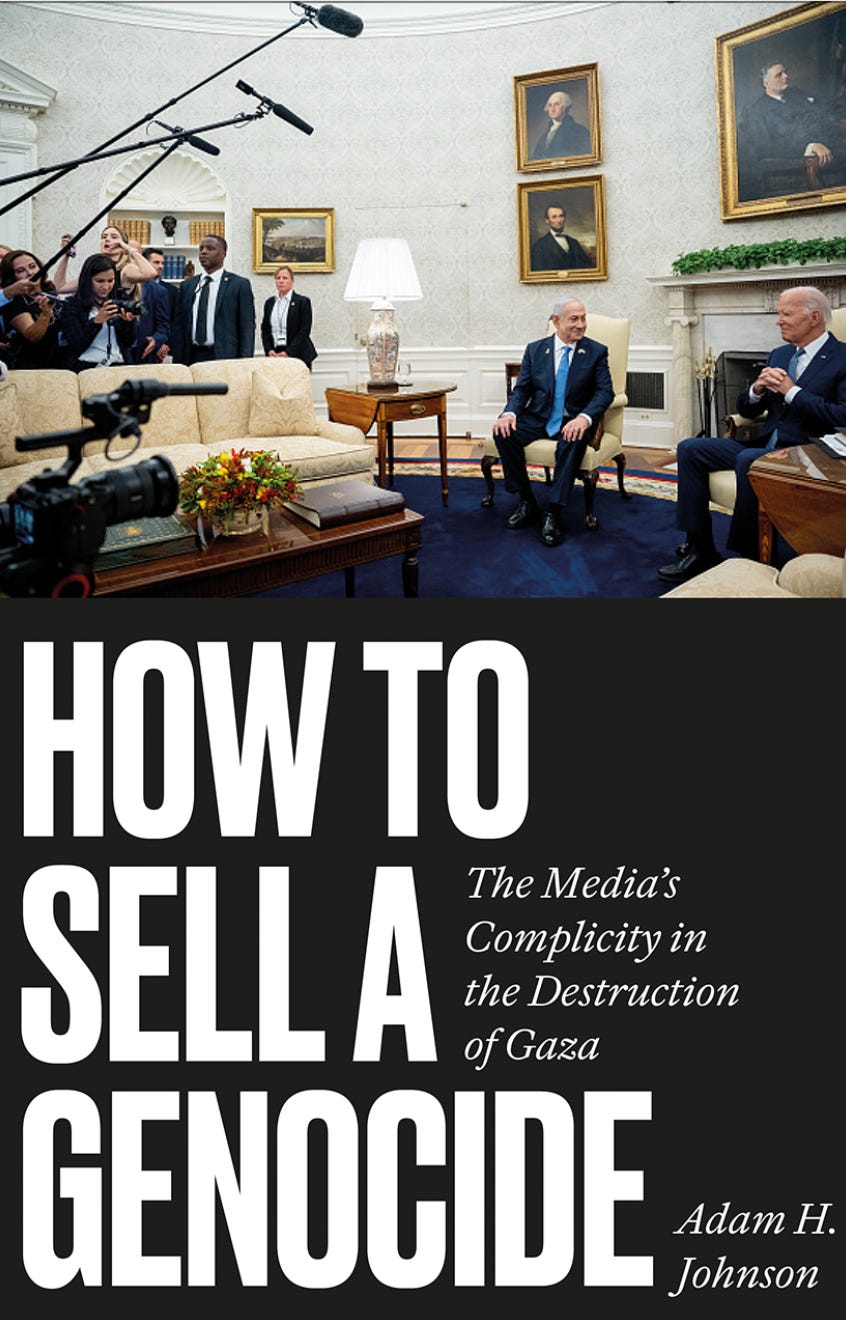
The short answer is, by telling a reassuring story. In How to Sell a Genocide: The Media’s Complicity in the Destruction of Gaza (Pluto Press), Adam H. Johnson presents a radically different story, one of a concerted, multifaceted PR campaign to keep the weapons flowing at all costs. While this campaign originated in the Biden administration, it was the media, most notably the liberal media, Johnson forcefully argues, that did the work of pitching the “war” to the public. “The purpose…,” as he puts it, “was to soothe, and make liberals…feel better about themselves,” to help them “compartmentalize, scroll past, and index” the genocide “as sad, but not something anyone in the West could really do anything to stop” (186).
For those who followed the assault on Gaza from its earliest days, much of what Johnson discusses will feel painfully familiar.2 As a steady observer, one is likely to have perceived, along with Johnson, the various patterns of governmental and media dishonesty that he teases out.3 What Johnson’s book brilliantly accomplishes is to confirm these hunches with data-based research and a cogent argument that puts all the pieces together. No, as many suspected, the Biden administration was not “working tirelessly to secure a ceasefire in Gaza,” notwithstanding Alexandria Ocasio Cortez’s notorious recitation of that talking point at the Democratic National Convention in August 2024. By then, the claim strained credulity. And yet even a skeptical observer might have been deluded at prior, seemingly hopeful moments that the policy of unlimited support for Israel was on the verge of changing—for example, when the Biden administration switched in February 2024 from talking about “humanitarian pauses” to employing the very term they had worked so hard to suppress, “ceasefire” (63). But as Johnson demonstrates with dispiriting acuity, such adjustments in language were always only public relations moves, forms of rebranding the same deadly and disastrous policy in order to keep it trundling along.
Johnson’s book confirms hunches about the media’s genocidal hucksterism with data-based research and an argument that puts all the pieces together.
Thankfully for his readers, Johnson is also a stylist. While disavowing language that is “needlessly polemical” and seeking to avoid “hinging too much of [his] argumentation on totalizing, emotionally-charged terms” (3), Johnson still makes witheringly effective use of irony. We see this, most notably, in the steady parade of capitalized phrases that bring out the emptiness of pro-war rhetorical postures—as with the credulous reporting of “Helpless Biden,” “Fuming Biden,” and “Deeply Concerned Biden” (51); the vacuity of “Ceasefire Theater” (197); and the insincerity of those “Feeling Sad about Gaza” but continuing to support the slaughter “With a Heavy Heart” (113) because “They [Israelis and Americans] Have No Choice” (114). Johnson reserves particular scorn for the notion of the “serious,” inevitably aligned with war and the status quo, and so we encounter, in turn, the “Very Serious Investigative Piece” (67), the “Serious Newsman” (114), the “Serious Foreign Policy Opinion” (168), “Serious Diplomacy” (200), and “a Very Serious Harvard Law Professor” writing in “a Very Serious magazine” (188). Somehow the “serious” people always cheerlead the latest disastrous war and then pop up again, having learned nothing, to support the next one. Needless to say, in such a frame, a ceasefire was cast as “either a Non-Sequitur or Deeply Unserious” (176).
Another hallmark of Johnson’s approach is his labor in poring over heaps of text and television coverage—“12,000 articles and 5,000 TV clips in nine major outlets” (2), with a focus on “the first year, and the first few months in particular” (5). While Johnson sees himself as a “prosecutor,” whose work crucially encompassed “interviewing sources who were in the room” when media decisions were discussed and made (2), he is also a kind of philologist, searching for keywords and themes that signal the tenor of coverage, that build a narrative—not to mention a social scientist, mapping the results with bar graphs, even in the most asymmetrical case studies. We see this, for example, in an emblematic comparison of the use of “emotive words”— “massacre,” “barbaric,” and “slaughter”—for killings of Israelis and Palestinians in the first 100 days of the war in select print media, MSNBC, and CNN (28–29). Although, by that point, “the official Palestinian death toll was roughly 24,000[,] with an estimated 70 percent of the victims being women and children…,” Johnson finds, “the use of [such] emotive words was almost entirely one-sided in favor of Israel” (26–27).
Johnson also has the conceptual (and polemical) chops to reduce these themes or rhetorical strategies to their embarrassingly bankrupt bottom line, as when he maps the “Moats of Rationalization” of the genocide. Thus, in far-right media we find “Mass Death Is Happening and It’s Good,” while in center-left and liberal-left media, we find such chestnuts as “There Is Mass Death and It’s Not Good but It’s Not Deliberate,” “We Need to Reduce Civilian Deaths,” and, finally, “Yes, Biden Is Doing Mass Death but Trump Would Do 10% More Mass Death” (6). As Johnson clarifies early on, his interest in the book lies in the discourse of the center and liberal left, not the far right, simply because the “pernicious nature” of the latter “is not in doubt or dispute.” When it comes to Fox News, the Daily Wire, right-wing AM radio, Sinclair News, and The Wall Street Journal, Johnson says, they are, “for the most part, openly genocidal against Palestinians and make no pretense otherwise” (3). On the other hand, in the “media consumed by Democrats” (4), coverage of the Gaza genocide was (and remains) more subtle, “packaged in the far more reasonable language of ‘nuance,’ ‘lowering the temperature,’ ‘combating antisemitism,’ savvy appeals to ‘complexity,’ and ‘limits on American power’ ” (6)—all of which required the erasure of Palestinians as anything other than terrorists or, at best, anonymous recipients of death and destruction delivered by a mysterious, agent-less, virtually climatic force.
That steady erasure of Palestinian voices, a leitmotif of Johnson’s discussion, is anticipated in a brief, powerful foreword by legal scholar Noura Erakat, who reminds us that the charge of genocide was not given a hearing in mainstream media until Israeli voices, such as Omar Bartov and David Grossman, became available to vouch for it, nearly two years in. As Erakat points out, “Palestinian scholars, activists, and advocates had named the Israeli campaign as genocide within a week of its start when 6,000 bombs had already been dropped on Gaza’s besieged population” (viii–ix). While “Bartov, Grossman, and others were provided platforms, treated as experts, and even celebrated as courageous,” Erakat writes, among the “Palestinian experts and journalists” who had “joined legacy media outlets to amplify the charge of genocide” in the fall of 2023, “none…were invited back” in July or August 2025, when the Israeli genocide acknowledgers were making the rounds (ix). Unlike the Palestinians, whose disappearance was “a result of censorship and blacklisting,” the Israelis allowed to appear on the air “preserved Israel’s essential innocence and framed the genocide as a rupture rather than a continuation of the Nakba” (x).4
Any Palestinians who did manage to get on the air in the weeks after October 7 would have faced not just the ritual demand to condemn Hamas but also the propaganda tsunami that rolled in with reports of “40 beheaded babies,” part of what Johnson dubs “the ISIS-ification of Hamas” (8) in his book’s first chapter. “The shocking viral story culminated,” as Johnson recalls, “with President Joe Biden telling reporters that not only had Hamas decapitated children, but that he had seen photos of the horrors himself” (10). The revelations that Biden had never seen any such pictures and that “the story was a whole cloth fabrication” (10) were never enough to undo the effect of its credulous circulation.5 Nor did the “fact that Hamas had long been in violent conflict with ISIS and had a completely different theological and ideological program” dissuade the Israeli government from “push[ing] out ads promoting the hashtag #HamasISIS” and “repeat[ing] this ‘Hamas is ISIS’ talking point during every media appearance in the weeks after October 7” (11).6 As Johnson astutely observes, the actual killings and kidnappings on October 7, which would have been enough in American eyes to justify some sort of Israeli military response, weren’t perceived as “sufficient to prime the…public with the requisite rage needed to justify…plans to render Gaza unlivable.” Hence the need “to embellish and—most important of all—racially code the attack in ways that US audiences would index as ontologically evil.” The Israelis “needed to foreclose on the possibility of a political solution and render demands for a ceasefire out of the realm of Political Seriousness,” Johnson writes, and “the quickest way to do this was to render [Hamas] ISIS-like in the minds of Western audiences” by “invent[ing] or exaggerate[ing] lurid stories”—“a task US media dutifully helped them achieve” (13).
At the same time, Johnson reports, “journalists at legacy outlets seeking to complicate the one-dimensional ‘Hamas is ISIS’ narrative were swiftly disciplined by corporate media executives and pro-Israel pressure groups” (13). Thus, “when two MSNBC anchors, Ali Velshi and Ayman Mohyeldin, made the mistake of trying to explain why militants in Gaza would attack southern Israel,… ‘People lost their shit at Comcast,’ ” the broadcaster’s parent company, as a source told Johnson (14). The result was that “NBC Middle East correspondent Martin Fletcher” was “brought out of retirement and made…the in-house expert that all on-air talent, journalists, producers, and editors were to reach out to when writing copy or building stories on what was happening in Gaza,” even though, or rather because, he could be relied on to “lis[t] off every pro-Israel cliché in the book,” as was apparent on “a phone call…arranged with…dozens of MSNBC staff members” (14–15). At CNN, a memo from CEO Mark Thompson said: “We will of course cover both the Israeli campaign in Gaza and the human consequences[,]…but we must continue to remind our audiences of the immediate cause of this current conflict, namely the Hamas attack and mass murder and kidnap[ping] of Israeli civilians” (15–16). And while “the most lurid, evidence-free claims could be tossed around about Palestinians and Palestinian violence,…this standard did not apply when discussing Israelis, whose alleged actions had to be triple vetted by the Israel-friendly CNN Jerusalem bureau” (16). Another consequence of executive interference, which Johnson mentions in passing in a later chapter, was that The Mehdi Hasan Show…was canceled by MSNBC about six weeks into the Gaza siege and bombing” (127).
On the fraught question of sexual violence on October 7, Johnson avoids “litigat[ing] the specifics around various allegations and counter-allegations,” focusing instead on “the immediate adoption of a broader claim…that systematic rape was part of Hamas’ ‘terror strategy,’ ” a claim used, like the beheaded babies story, as “evidence of an organization for which any political settlement or ceasefire [was] not only impossible but morally reprehensible” (19). The leading edge of this campaign was the New York Times story “Screams without Words: How Hamas Weaponized Sexual Violence on Oct. 7,” which ran on December 28, 2023. Johnson highlights, as many others have done, the fact that the piece was co-written by “a heretofore obscure freelancer, Anat Schwarz,” who on October 7 had “liked a tweet that Israel needed to ‘turn the strip into a slaughterhouse’ ”—her entrée into authorship of this blockbuster story contrasts sharply with the treatment of “dozens of Arab and Palestinian journalists…who were fired, taken off the Gaza beat, reprimanded, or otherwise sanctioned for making generic statements about Palestinian suffering on social media” (19–20). As Johnson acknowledges, “the sloppiness, poor sourcing, and obvious bias” of the Times article “is not per se evidence that no sexual assault took place on October 7,” but “it does speak to an ideological motivation…and the lowering of editorial standards when a story helped fuel Israel’s so-called ‘war on Hamas’ ” (20). At the same time, despite “numerous credible reports that the Israeli military employed widespread rape against Palestinian captives,” as “confirmed by Israeli courts and recorded on video,” these reports garnered “only two…mentions…on CNN and MSNBC in the relevant time frame,…in stark contrast with the 502 on-air mentions of Palestinians engaging in mass rape against Israelis” in a comparable three-month period (20–21). “It is impossible,” Johnson writes, “to avoid the fact that completely one-sided discussions of rape have been used at the most pivotal moments since October 7, 2023, to justify further escalation of Israeli aggression.”7
The killings and kidnappings on October 7 were not perceived as sufficient “to prime the…public” for “plans to render Gaza unlivable.” Hence the need “to embellish and…racially code the attack.”
A further turn in the pro-war propaganda campaign emerged, as Johnson shows, in the aftermath of the October 17 “ ‘explosion’ on the edge of the Al-Ahli Arab Hospital in Gaza City,” which “killed over 250 Palestinians, the majority seeking refuge in a tent camp in the hospital parking lot.” Though “major outlets like CNN and the New York Times justifiably assumed the military entity dropping 99.99 percent of the bombs on Gaza was the responsible party,…Israel, of course, contested its responsibility, using as evidence a supposed intercepted phone recording between Palestinian militants,” which was found to be fake within hours, as “it employed ‘absurd’ Arabic ‘tone, syntax, accent and idiom’ ” (33). Even so, “under pressure from the White House, the Israeli government and pro-Israel groups, US media largely validated the ‘errant Islamic Jihad rocket’ narrative or, at best, indexed the ‘explosion as [a] ‘Fog-of-War’…mystery that could never be known one way or the other.” Consequently, “what could have been a galvanizing moment for global opinion to marshal support to end the ongoing mass killing…was inverted, with essential assistance from US media,” into a demonstration of “anti-Israel bias in US media.” In the face of “a successful crybully campaign,” the media, “to varying degrees,” introduced “entirely novel editorial standards of attribution for IDF attacks, requiring positive confirmation from the IDF,” and started deploying “the pejorative qualifier ‘Hamas-run’ or ‘Hamas-controlled’ to Gaza’s health ministry “to discredit the…ballooning death count” (34)—which Israel itself would acknowledge was accurate two years later, when the numbers no longer threatened its military campaign.8 (Biden himself lent a crucial hand by publicly doubting the death toll in late October 2023.)9 Another phrase that did a lot of work was the qualification that casualty figures “did not ‘distinguish between civilians and combatants,’ ” as the Times put it (37)—using a trope that would be gratefully picked up by the liberal Zionist publication The Forward whenever such mortifying death tolls had to be reported.10
In another oft-remarked bit of reality shaping, Palestinians held in captivity by Israel were never referred to as “hostages,” though “Israel keeps, and has kept for years, over 3,000 Palestinian captives without charge.” As Johnson notes: “These are Palestinians…, kidnapped from their homes or off the streets, not formally accused of a crime, presented with no evidence, given no trial, held indefinitely, often tortured and sexually assaulted, and used as bargaining chips” (40). In a related erasure, while “Israeli captives under the age of 18 were referred to as ‘children,’…Palestinian captives under the age of 18 were referred to as ‘minors,’ ” sometimes “in the exact same paragraph” or even the same sentence (41). Ironically, when Johnson “asked Standards Editors at [the] Times about their…double standards, they responded” with more of them. In an email, the managing director for external communications reproduced in miniature the signature lack of emotive or moral language around Israel’s acts of killing or even the imputation of agency to its military, speaking all in the same message of Israel’s “ferocious military campaign,” “the atrocities committed by Hamas,” and “the humanitarian crisis facing communities in Gaza.” The message, unsurprisingly, went “on to use pro forma language about how [the] Times is also accused of being pro-Palestine”—a “mopey Golden Mean Fallacy response typical of those presented with manifest evidence of pro-Israel bias” (43).
In the case of the Canadian Broadcasting Company (CBC), the response from the senior manager of journalistic standards betrayed a similar obtuseness, arguing that words like “murderous,” “vicious,” and “brutal” are justifiably applied to the close-range violence of the October 7 attacks but not to “bombs dropped from thousands of feet and artillery shells lofted into Gaza from kilometers away.” As Johnson points out, “No one defending these obvious discrepancies” in language “can ever piece together a coherent reason why these two modes of killing are substantially, morally different.” Presented with Johnson’s analysis by Al Jazeera, Jodi Rudoren, the editorial director of newsletters at the Times, “responded, as Johnson says, “with a similar circular nonanswer”:
There was a massacre on Oct. 7, there were atrocities committed, it was barbaric…. The [Israeli] response was intense, it involved a lot of death, destruction, and displacement. But I’m not sure “massacre,” “barbaric” and “atrocity” are appropriate terms…. You’re talking about two very different things and they deserve different adjectives. (45)11
The unspoken principle underlying this double standard is that words like “barbaric” and “savage” have “racialized connotations” and “are steeped in colonial history,” as Johnson notes, having been “used for centuries to dehumanize indigenous people, often in contrast to ‘civilization’ ” (49). Casting the genocide as a war between “civilization” and “barbarians” offered “an easy, cheap framework for dehumanizing Palestinians and morally compartmentalizing a rising Palestinian death toll that, very early on,” it was clear, “would be unprecedented in scale” (49–50).
While there is much in Johnson’s book to inspire disgust, it may be possible to single out the chapter entitled “How US Media Helped the Biden Administration Distance Itself from the Horrors of Gaza”—not so much for the media’s role, in this case, as for the disgraceful behavior of the administration itself, which clearly peddled those tales of Helpless Biden and Fuming or Deeply Concerned Biden to sympathetic journalists as a form of exculpation. The genre of “Helpless Biden,” Johnson writes, encompassed “any report, analysis, or opinion that describe[d] Biden as unable to do anything to stop Israel from committing war crimes or end the war overall”; “Fuming/Deeply Concerned Biden,” in turn, included “any report, analysis, or opinion that painted Biden as secretly upset, outraged, or privately sad or anguished about civilian casualties in Gaza” (51). Both genres, Johnson reports, were “sourced almost entirely by anonymous Biden aides and Biden allies in the think-tank world” (52), along with Israeli officials (55, 59). (To Johnson’s analysis, we might add the steady marketing of Biden as a “decent man,” a brand that Biden himself sought to shore up with his tormented expressions in the face of pro-Palestine hecklers and his useless concession: “They have a point.”) Johnson’s analysis, he says, rests, first, on the premise that Biden “could have ended Israel’s bombing, siege, and occupation of Gaza whenever [he] wished and chose not to.” Biden’s power to end the war, Johnson rightly observes, “was well-documented and widely understood at the time” (52)—and confirmed in April 2025 by Israeli ambassador Michael Herzog, who remarked: “God did the State of Israel a favor that Biden was the president…. We fought [in Gaza] for over a year and the administration never came to us and said, ‘ceasefire now.’ ”12 A second premise—that “those in the Biden White House had obvious professional, social, political, and moral reasons for wanting to promote the idea that they were not responsible for the daily atrocities”—speaks for itself, since, “from the beginning Israel was credibly accused of a host of war crimes by Human Rights Watch and Amnesty International,…and had been credibly accused of ‘plausible’ genocide by the International Court of Justice” (53). “To make these non-stories” of Fuming/Deeply Concerned Biden “seem newsier,” Johnson says, reporters “often peppered” them with “direct or implicit claims of a just-around-the-corner ‘break’ between Biden and Netanyahu” (60). And, when it comes to “just-around-the-corner” breakthroughs, who can forget the indelible image of Biden, momentarily deferring the pleasure of an ice cream cone on February 26, 2024, to declare: “My national security advisor tells me that we’re close…. And my hope is that by next Monday we’ll have a ceasefire”?
Who can forget the indelible image of Biden, momentarily deferring the pleasure of an ice cream cone to declare: “My hope is that by next Monday we’ll have a ceasefire”?
In this chapter, Johnson also unpacks a genre he calls “Third-Partying,” whereby “media reports consistently paint[ed] the United States as separate from the conflict,…a neutral third party—even a humanitarian force—always looking (but mysteriously, always failing) to end the conflict” (52). In keeping with this framing, “there were thousands of examples in US media of editors taking for granted that the United States was earnestly seeking a ‘peace deal,’ ‘truce,’ or ‘ceasefire,’ but simply couldn’t bring Israel and Hamas to agree to terms,” even though the Biden administration “could have simply imposed a ceasefire on Israel whenever it chose to do so, but never did so.” As Johnson was particularly astute in noticing at the time, “much of the heavy lifting” in “this Third-Partying PR effort” was accomplished “through the shifting, extremely malleable definition of ‘ceasefire’ ” (62). “Historically,” he says, “ ‘ceasefire’ means both parties stop firing, not that one party [is] crushed militarily or capitulate[s]” (64). However, the Biden administration “routinely made mutually exclusive statements about their desire to ‘end the war,’ while saying Hamas could ‘have no role in post-war Gaza’ ” (62). Since, in fact, “this wasn’t a call for a ceasefire” but rather “a call for, in Netanyahu’s phrasing, ‘total victory,’ ” Johnson writes, “ ‘pushing for a ceasefire’ meant ‘continuing to bomb and besiege Gaza while reiterating terms of surrender,’ ” or it could mean “hostage negotiations, but with a firm commitment to continue the ‘war’ once Israeli captives were freed” (63). Johnson depicts what he will later call “Ceasefire Theater” as follows:
Important people showed up…in suits, talked about “making progress,” and “sought an end to the war,” and reporters took their efforts at face value…. To the extent that there were any real negotiations…, they had been…confined to discussions about hostage exchanges, which, both the US and Israel made clear, would explicitly not end the war but provide a brief pause like the one in November 2023. (64–65)
Meanwhile, “liberal Americans consuming mainstream US news from February 2024 to the end of Biden’s tenure,…reading coverage of the ‘ceasefire talks’ and reports of a perpetually frustrated, angry and thwarted Biden,…would have the distinct impression the White House was a bumbling, uninvolved humanitarian third party overwhelmed by forces outside of their control” (65).
Ah yes, and who could name the overwhelming forces in whose path “buildings…mysteriously collapse and lives…mysteriously end,” as Omar El-Akkad has put it? For Johnson, the journalistic practice of obscuring responsibility for those Palestinian deaths amounts to “Covering War Crimes like Earthquakes,” as he describes the phenomenon in one of his chapter titles (66)—that is, “report[ing] on mass death as one would an earthquake or tornado,” as “an act of god with a vague or uncertain human agent or political antecedent” (67). This genre, the “Natural Diasaster-izing of Israeli War Crimes,” took the form of “Breaking News,” e.g., “Explosion Gazans Say Was Airstrike Leaves Many Casualties in Dense Neighborhood,” or what Johnson terms “the Very Serious Investigative Piece,” which is “typically glossy Pulitzer-bait that’s well-reported in the strict sense…, but—when it comes to Gaza—very light on outlining moral responsibility or (explicit or implicit) calls to action” (67–68). In the case of Breaking News, “a brief review of the New York Times’ front-page coverage documenting Israeli war crimes and/or mass death shows human agency is almost always removed from…headlines,” reflecting a reticence that the paper of record never had concerning Russian attacks on Ukraine (68–69). Likewise, in a survey of “the eight major Very Serious Investigative Pieces for the…Times detailing Israeli war crimes and their impact on Palestinians, Israel is not mentioned in any of the headlines or sub-headlines.” Worse, “in two prominent articles, ‘Pregnant in Gaza with Nowhere to Go’…and ‘With Schools in Ruins, Education in Gaza Will Be Hobbled for Years’…, Israel’s central role in creating the horrors in question is not mentioned anywhere in the article text at all.” In a story titled “The 10-Year-Old Boy Who Has Become the Face of Starvation in Gaza,” there is no “mention of the dozen points of evidence detailing Israel using starvation as a weapon of war, nor…any mention of public statements made by Israeli officials detailing this strategy” (73).
For Johnson, the journalistic practice of obscuring responsibility for Palestinian deaths amounts to “Covering War Crimes like Earthquakes.”
While helpfully eliding self-incriminating statements by Israeli leaders, the media was all too happy to take their word for whatever fabricated information they were interested in spreading, as we see most acutely in a chapter entitled “How the New York Times Helped Israel Militarize Civilians, Humanitarian Workers in Gaza.” By remarkable coincidence, just as the International Court of Justice was announcing that the charge of genocide was “plausible,” on January 26, 2024, Israel was notifying UNRWA, the relief agency for Palestinian refugees, that twelve of its workers were involved in the October 7 attack, “quickly pushing” the bad publicity of the ICJ “story off the front pages” (82). As Johnson notes, “One recurring feature of New York Times coverage of the ‘Israel-Hamas war’ is that the Israeli government, as a source, is never categorically discredited,” as “their history of self-serving, since-debunked lies is never brought up.” Rather “readers are given the impression that these are credible ‘officials’ with serious, well-sourced ‘intelligence’ seeking to provide ‘information’ on ‘terrorists’ ” (83). Johnson cites Muhammad Shehada13 of the European Council on Foreign Relations for a list of six lies from Israeli officials documented in the first sixty days of the war, including the claim of a “Hamas tunnel” at the Qatari Hospital in Gaza (actually an underground water tank); a denial of having killed some 70 fleeing refugees on October 13; a denial of having tortured a Palestinian detainee in November; a claim that a calendar in the al-Rantisi children’s hospital was a list of terrorist guards; a claim that a dead child in Gaza was a doll; and a denial that Israel bombed Gaza and Lebanon with white phosphorus (83–84). All the same, on the Times homepage on January 27, 2024, the news of “the UN court finding that Israel was committing ‘plausible’ acts of genocide and calling on [it] to cease doing so,” as Johnson puts it, was rendered as “the International Court of Justice ruled that Israel must prevent genocidal acts in Gaza, but did not call for a cease-fire,” whereas “in [a] font twice the size and above the headline about the ICJ’s ruling, Israel’s tabloid claims of [an] UNRWA-Hamas conspiracy [were] presented as per se credible because the UN fired the employees in question” (87). Going even further, The Wall Street Journal ran an article claiming that “10% of the Palestinian aid agency’s 12,000 staff in Gaza have links to militants” (88). Months later, as reported in Semafor, an internal memo from the newspaper’s chief news editor said, “The fact that the Israeli claims haven’t been backed up by solid evidence doesn’t mean our reporting was inaccurate or misleading, that we have walked it back or that there is a correctable error here” (88–89). In its reporting on the drummed-up UNRWA scandal, the Times “repeatedly…left unmentioned that the Israeli right had been working to remove UNRWA from Gaza for years…not only because it provided life-sustaining aid…but because…it reinforced the premise that the majority of those in Gaza are refugees—which they…remain in the eyes of international law” (90–91).
The real-world consequences of the media’s broadcasting of Israeli propaganda were grim. “Immediately following the one-two punch from the…Times and the Wall Street Journal,” Johnson writes, “over a dozen Western countries initially pulled funding from UNRWA,” though “over the next few months, all but the US went back to funding [it], because it became increasingly clear that Israeli claims were a smear campaign without any credible basis.” And then, “over a year later, once the smear campaign had served its purpose and UN aid had been all but decimated and starvation in Gaza [had become] widespread, the media had mostly moved on” (89). Worse, hundreds of Palestinians would be killed by gunfire while seeking food from UNRWA’s ostensible replacement, backed by the US and Israel, the Orwellian “Gaza Humanitarian Foundation.”14
In another huge propaganda lift for Israel, the Times “repeatedly referred to places that Israel was bombing, invading, or starving—typically with dozens or hundreds of civilian deaths—as ‘Hamas strongholds,’ ” meaning, “in effect, whatever area or building Israel was attacking at the time” (91). For “one typically sleazy example,” Johnson points to the use of that phrase in a Times headline concerning “the IDF bombing of the Jabalia refugee camp that killed upwards of 120 people (including dozens of children)” on October 31, 2023. As Johnson found, the Times “used the term ‘Hamas stronghold’ and variations of the phrase 154 times from October 2023 to October 2024, almost always while reporting on war crimes or pending war crimes” and even used it for “the top five most populated cities in Gaza” (92). “If every major population center—the only five cities with over 100,000 pre-war population—in Gaza is a ‘Hamas stronghold,’ ” Johnson asks, “then how is this a meaningful label?” The answer: “It has no analytical utility other than to not-so-subtly militarize the entire civilian population of Gaza in the mind of the reader…. If spatial proximity to Hamas fighters means one’s killing is already justified, then Israel has a built-in justification for eliminating or displacing anyone and everyone in the 25-by-5-mile…strip…—which is, of course, the whole point of the stronghold label” (93). The Times, Johnson adds, was “central to selling liberal readers on the general idea that Israel could wholesale level all of Gaza, and it was justified because an elaborate maze of Hamas tunnels was virtually everywhere” (93–94)—an argument made explicitly by Israel’s ambassador to the UK in January 2024.15
Perhaps the most shameless lie, however, and the “most consequential intelligence laundering effort” by the Times, Johnson argues, may have been the “panicked copy-and-paste job detailing an alleged ‘Hamas command-and-control center’ under Al-Shifa Hospital in the lead-up to the bombing and raiding of the hospital in November 2023” (98). In this case, “a 3D rendered video on October 27, 2023, supposedly show[ed] what appeared to be a Bond Villain-like ‘Hamas command-and-control center’ buried underneath Al-Shifa Hospital.” The video, as The Washington Post later reported, was “an animation the IDF had used the previous year, saying at the time it was a tunnel beneath a UN school” (84–85). All the same, as part of the narrative building, the Times “would frequently present the hospital as a war zone, with patients caught in the middle of two opposing, symmetrical armies in a ‘battle,’ despite Israel never providing any evidence that shooting was coming from the hospital itself” (99). In the Times, “only ‘Hamas’ ever denied the accusation that there was an elaborate terror lair under” the hospital. The “human rights groups and medical staff who worked, or had worked, at the hospital recently…were simply ignored” (100). Further, though “Israel controlled the hospital complex for weeks during various occupations and never once produced any evidence” of the alleged tunnels, the Times did not “mak[e] this the story” but opted instead to “dres[s] up a totally unrelated claim using ‘classified Israeli intelligence’…that there may have been a single tunnel approximately underneath Al-Shifa that didn’t touch the actual hospital.” In other words, “rather than frame this as a story of Israeli officials lying, repeatedly and with a clear motive to do so, with the aim of exterminating or removing hundreds of patients and medical staff…, it’s presented as Israeli officials being wrong—but maybe sort of right if you squint hard enough” (101).
In a study of the Sunday morning news shows, from October 2023 to October 2024, Johnson found only a single Palestinian guest.
Turning to “so-called ‘agenda-setting’ TV news and editorial boards,” including The Washington Post, the daily weekday show Morning Joe (“Biden’s favorite program”), “the weekly Sunday news programs,” and of course the Times, Johnson demonstrates “their overwhelming pro-Israel bias, erasure of Palestinian voices, and open incitement in favor of more bombing” (103). In “a study of the coverage of NBC’s Meet the Press, ABC’s This Week with George Stephanopoulos, CBS’s Face the Nation, and CNN’s State of the Union (with Jake Tapper and Dana Bash), from October 2023 to October 2024,” Johnson “found that of the 208 hours the Sunday shows were on-air, only one” of them, Face the Nation, “featured a single Palestinian guest—Husan Zomlot, the Palestinian ambassador to the United Kingdom,” on November 5, 2023 (103–4). Conversely, the same shows “featured Israeli guests 20 times,” including five appearances by Netanyahu. In addition, “White House officials appeared 59 times, most frequently” national security adviser Jake Sullivan, national security communications adviser John Kirby, and Secretary of State Antony Blinken, who appeared, respectively, twenty-one, sixteen, and ten times (104, 107).16 Weighing Bash’s two interviews with Netanyahu, Johnson finds that in the first one, in November 2023, “she began by accepting the premise that Al-Shifa Hospital…was sitting atop a ‘Hamas command-and-control center’ ” and “parroted the US State Department’s mild chiding about whether or not ‘too many civilians have died,’ ” though, in her second interview, in March 2024, she “avoided issues of civilian deaths altogether.” As Johnson notes, “the average media consumer would be totally ignorant of [the] lopsided civilian suffering” on the Palestinian side “from watching the Sunday shows,” which, as with media previously considered, leaned into words like “massacre,” “slaughter,” and “brutal,” all overwhelmingly applied to violence against Israelis (105), as well as mass rape, “human shields, “Hamas-run,” “right to defend itself,” “Israeli hostages” (versus much less frequently evoked “Palestinian prisoners”), and “antisemitism” (versus much less frequently mentioned Islamophobia, 106–7).
Circling back to the Times editorials, Johnson tracks the maddening obtuseness displayed from the first one, on October 9, 2023 (“The Attack on Israel Demands Unity and Resolve”), through February 24, 2024 (“A U.S. Call for a Humanitarian Cease-fire in Gaza”)—though we might extend the analysis all the way through the entirely predictable conclusion of the sequence, “This Terrible War Must End” (September 30, 2025). In Johnson’s reading of the six editorials in that six-month period, “all…supported the basic premises of Israel’s assault…, and none…called for a permanent ceasefire or a political solution.” Rather, the Times “largely echoed the Biden White House line,…placing the primary blame for the carnage on Hamas [and] reiterating terms of surrender, all while feigning Deep Concern for the increasingly embarrassing and inevitable carnage” (108). The Times, “like the White House,” Johnson writes, “wanted to feed Palestinians so they could be bombed on 600 calories a day.” In an editorial on December 8, 2023, the paper “argu[ed] in favor of Congress shipping another $14.3 billion in weapons to Israel so it could continue leveling Gaza,” as Johnson says, but was quick to reassure “liberal readers” that “it only supported the record-breaking arms transfer because ‘Mr. Biden and Secretary of State Antony Blinken have urged Israel to reduce the number of civilian casualties’ ” (109). As for The Washington Post, we encounter “twelve editorials in the first six months, all of which supported the assault on Gaza but, like the…Times, did so with a…Very Heavy Heart” (110).
Appropriately, Johnson dedicates several pages just to CNN’s Jake Tapper, “the quintessential Serious Newsman,” who was, in fact, “a major vector of pro-Israel disinformation, distortions and demagoguery” (113–14). “Repeatedly,” Johnson reports, “Tapper promoted the canard that Palestinians wanted more dead Palestinians and their widespread death at the hands of Israel was actually part of a sinister Hamas strategy of Jihad that, somehow, forced Israel to kill as many civilians as possible in a callous effort to solicit global sympathy” (114). Asking in November 2023, “What exactly did Hamas think the Israeli military would do in response to [October 7]?,” Tapper, unsurprisingly, never allowed his imagination to venture any further back than that baneful day. As Johnson asks, rhetorically, “What…did Israel expect after it laid siege to Gaza for 16 years and killed over 500 children in their 2014 bombing campaign?” “Surely,” he adds, “any supposedly straight newsman making such a flippant comment after the October 7 attack would be fired and accused of justifying the killing of innocent people, but when Tapper does it as Palestinian deaths mount—with a death count ten times that of October 7 (that would go on to balloon to upwards of 100 times)—it’s seen as a savvy, hard truth.” Reading Johnson’s account of a segment on December 9, 2023, with Joseph Braude from the Center for Peace Communications, “a Zionist advocacy group posing as a ‘peace’ organization,” one is reminded of Tapper’s recent consultation with Zionist propagandist Emily Schrader on what Iranians want (to be bombed, as it turns out).17 As in the Schrader interview, Braude was recruited to expound on what bombed people really want, or in this case “what ordinary Gazans think about Hamas” (115). “The showstopper” of the segment, which consisted “supposedly [of] testimonies smuggled out of Gaza and read by voice actors, accompanied by animations,” was offered by a “Gaza resident” who managed to “ech[o] every talking point of the Netanyahu administration”: “At this time,…in the prison that is Gaza, my prime and immediate enemy is Hamas…. We’re condemned to suffer because of this stupid organization. Who made us live in poverty…? Not the Jews—Hamas” (116–17). Tapper has “also made a habit of either explicitly saying, or more often…, coyly implying that Israel’s critics [are] motivated by antisemitism,” as in his “sleaz[y]” smear of Rashida Tlaib, which entailed imputing to her something she did not say. Dana Bash eagerly joined in, “add[ing] in mopey tones, it was a ‘sad reality’ that ‘antisemitism is everywhere and it comes from both ends of the political spectrum’ ” (118).18
“Repeatedly,” Johnson reports, CNN’s Jake Tapper “promoted the canard…of a sinister Hamas strategy…that, somehow, forced Israel to kill as many civilians as possible.”
Another standout in the campaign to sell the Gaza genocide turns out to be Morning Joe, which Johnson refers to as “the most aggressively anti-Palestinian show on MSNBC and perhaps cable news in general.” In the period of study, from October 2023 to October 2024, the show “did not feature a single Palestinian guest despite platforming, uncritically and fawningly, dozens of Israeli officials and pro-Israel commentators” (119). It also punched above its weight in deploying “massacre,” “barbaric,” “savage,” and “slaughter” to describe the killing of Israelis, using the last of these words only once for the killing of Palestinians (in a slip-up by political analyst Elise Jordan, who quickly added, “I’m all for—I think Israel deserved to have a robust response to kill Hamas,” 119–20). Scarborough, Johnson points out, was still repeating the “beheaded babies hoax” nearly two weeks after it had been debunked (120).
In a chapter entitled “Selective Empathy and Liberalism’s Crisis of Legitimacy,” Johnson surveys how “throughout media newsrooms, within press associations and universities, and among adjacent liberal nonprofits, new standards against violating ‘impartiality’ or ‘neutrality’ were invented post-October 7” (122). As in other analyses, the Russian invasion of Ukraine provides a telling comparandum. “Victims of Israel’s attack on Gaza who could be expected to elicit sympathy from audiences—like journalists, refugees, and children—received little coverage during the first 100 days…compared to their counterparts in Ukraine.” In the latter case, “262 children were killed” versus “more than 10,000” in Gaza, but “mentions of child deaths and related terms were” still “33.4 higher for Ukraine than for Gaza” on CNN and MSNBC. Similarly, though in Gaza, “77 journalists were killed…versus eight in the first 100 days of Russia’s invasion,” the two “were given roughly equal mention” (123). To make things worse, “IDF claims that” the murdered journalists “were ‘Hamas-linked’ or ‘Hamas-affiliated’ were mindlessly repeated by outlets like the…Times and CNN,…dulling any outrage that would otherwise stem from the repeated, nonstop targeting of reporters in Gaza” (123–24). Similarly, “in the first 100 days of the respective conflicts, CNN and MSNBC covered Ukrainian civilians suffering almost twice as often as they covered that in Gaza, despite the latter’s having a civilian death toll, during the allotted time frame, 500 percent greater than the former” (125). Additionally, “on CNN and MSNBC,” Johnson finds that in the first thirty days, “the words ‘war crime’ or ‘genocide’ were mentioned over 17 times more in the context of Ukraine than they were in the context of Gaza” (127).
In the new regime of “impartiality,” the list of people fired from their jobs for speaking out on Gaza is voluminous; Johnson refers to just a few high-profile cases, such as Michael Eisen, the editor-in-chief of eLife, an academic journal, who was canned for quoting a typically incisive Onion headline: “Dying Gazans Criticized for Not Using Last Words to Condemn Hamas” (135). David Velasco, editor of Artforum for six years, was fired for “publish[ing] an open letter signed by thousands of artists, academics, and curators calling for solidarity with Palestinians and for a ceasefire” (136). Joy-Ann Reid, “one of the few voices in cable news to engage in bare minimum humanization of Palestinians, was abruptly fired from MSNBC in February 2025 due, in part to her coverage of Gaza, according to Reid” (137). More broadly, “the May 2024 National Writers Union report detailed over 100 different cases of retaliation against media workers in the months after October 7 because these workers expressed undue sympathy for Palestinians,” compared, Johnson says, “with the zero American media workers fired after Russia’s invasion of Ukraine,” though “expressions of solidarity and open support for Ukrainian fighters were widespread” (139). The crux of the matter, as Johnson rightly detects, is “taking a position in liberal institutions is fine so long as it doesn’t meaningfully offend the prevailing hegemonic worldview” (139–40). However, “liberal institutions…can’t acknowledge that they are instruments of ideological disciplining[,] so they frame their punishment…under the selective and dubious auspices of ‘neutrality.’ ” Thus, PEN America, which “had explicitly condemned Russia’s invasion of Ukraine,” ended up rejecting for months “the demand [from members] that [the organization] back a ceasefire” (140). Likewise, though in 2022, Harvard “did not hesitate to express empathy and explicitly take a side” vis-à-vis Ukraine, in May 2024 it “announced that it would, according to the…Times, ‘no longer take positions on matters outside of the university’ ” (141). Indeed, “a survey of [the] top 25 US News and World Report colleges found that 50 percent…issued statements of support for Ukraine and/or Israel in February 2022 and October 2023, respectively, only to do a 180…and issue formal policies against the university taking stands on political issues.” Furthermore, ten states “passed legislation in mid-2024, all crafted by pro-Israel organizations, requiring ‘institutional neutrality’ for their public university systems to both prevent public statements in opposition to the genocide in Gaza and stem popular campus movement[s] toward divesting in Israel and Israeli military firms” (142). The upshot: “Openly supporting Israel’s genocide was untenable, but opposing it in any meaningful way was career and fundraising poison. So liberal institutions…invented new, ostensibly neutral standards of impartiality out of thin air to try and dodge the issue altogether, almost always drowning in the faux-savvy language of ‘complexity’…and ‘nuance’ ” (144).
Focusing on universities in a chapter entitled “ ‘Antisemitism’ Show Trials and the Smearing of Campus Protests,” Johnson notes that “by the end of 2024, some 3,100 people, mostly students, throughout the US had been detained or arrested, and thousands more faced harsh university discipline—suspension, expulsion, and loss of degree” (145). “As…campus protests took root,” Johnson writes, “a framing began to emerge in US media and the halls of Congress: The primary victims of the bombing and siege of Gaza were not the Palestinians…but rather ‘Jewish students’ on US campuses who, we were consistently told, were being made to ‘feel unsafe’ and under siege” (146). In the genre of what Johnson calls “the Campus Antisemitism Trend Piece,” which was “designed to lend liberal legitimacy to the narrative that anti-war protests were not motivated by a desire to stop the killing of countless children in Gaza, but [were] a manifestation of otherwise latent anti-Jewish hatred,” the hallmarks included “cherry-picked examples, unverified self-reporting, no examination of pro-Israel pressure groups’ potential ulterior motives,…a complete conflation of Jewish religious and cultural identity with Zionist ideology,” and “a gloomy photo of a ‘Jewish student’ looking sad and alone on campus to convey their desperation and alienation” (147). As Johnson adds: “The conflation of pro-Israel activists with ‘Jewish students’ was routine in US media and gave readers the broad impression that campuses were on the verge, or in the middle, of antisemitic pogroms” (149). “One way this distortion was propped up,” Johnson writes, “was the constant erasure of Jewish leadership and participation in campus protests, and simultaneously the consistent centering of pro-Israel Jewish students” (154).
“The conflation of pro-Israel activists with ‘Jewish students’ was routine in US media and gave readers the broad impression that campuses were on the verge, or in the middle, of antisemitic pogroms.”
In the same chapter, in another tour de force survey of comparative coverage, Johnson considers the quantity of ink spilled and air time devoted to the ginned-up scandal concerning Harvard president Claudine Gay versus the murder of five-year-old Hind Rajab by the IDF, “along with six of her family members and two paramedics, who were gunned down on January 29, 2024[,]…as they attempted to rescue her” (161–62). As Johnson aptly observes, “Hind’s heart-wrenching emergency call made global headlines and…could have been [another] galvanizing moment against Israel’s ongoing genocide” but was, “instead, largely ignored by US media, relegated to a scattering of articles and two CNN segments before quickly disappearing from the list of things Americans were led to care about.” As Johnson adds with characteristically caustic irony: “For the purposes of comparative analysis we are asserting that the US-backed killing of a small child, her family, and medical rescue workers is objectively more newsworthy than bad-faith Republican questioning of a university president, followed by allegations that said president may or may not have committed plagiarism decades prior.” And yet “during the peak of the Claudine Gay fervor,” the month between early December 2023 and early January 2024, “major US print/online publications ran a total of 207 different stories about or including substantive mention of Claudine Gay” compared with five articles on the killing of Hind Rajab in the month after she was murdered. On cable news, “CNN mention[ed] Gay 409 times and MSNBC mention[ed] her 210,” whereas “CNN mentioned Hind Rajab 29 times in a total of two segments” while MSNBC did not deign to mention her a single time on air in that period (162).
“Even if one accepted the narrative that there was widespread antisemitism on college campuses,” Johnson writes, “using the same standard of evidence, one would have to conclude there also existed a massive uptick in Islamophobia or anti-Muslim, anti-Arab, anti-Palestinian racism.” But, of course, “only one of these narratives was made central…and substantively covered,” though “anti-Muslim hate/Islamophobia” was often mentioned in what Johnson dismisses as “a box-checking exercise” (165)—“a ‘to be sure’ paragraph, or a throw-away line.” The latter “was not a narrative, much less a moral crisis in urgent need of firings, denial of college degrees, and hundreds of arrests and deportations” (169) for the obvious reason that the moral panic around antisemitism had a specific purpose: “to distract” from, to “trivialize,” and to “implicitly justify” the suffering and killing of Palestinians in Gaza (170).
In another, more rarefied register of selling a genocide—to “the tote bag set,” as Johnson calls them—we encounter The Atlantic and, at the Times, David Leonhardt, both “on the forefront of… pushing the concept of a ceasefire outside the realm of Seriousness” and “lending credibility to Gaza death count denialism” (171). Speaking of The Atlantic’s editor, Jeffrey Goldberg, “a former IDF prison guard, who…admits to assisting in the torture of Palestinian prisoners during his jaunt into elective Zionist militarism in the late 1980s and early 1990s,”19 Johnson writes that Goldberg shaped an opinion and reporting output that—with very rare exception—reinforced every premise of the genocide, especially in its early, critical weeks” (172). Examples include a piece by Gal Beckerman (“The Left Abandoned Me”), which “platformed the ‘beheaded babies’ lie, a claim that” the magazine “still refuses to retract.” The Atlantic “also purveyed openly racist ‘clash of civilizations’ missives, and dozens of articles embracing the…sectarian framing” that spoke of “an attack on Jews rather than Israelis.” As for “opposing a ceasefire in Gaza and deriding the idea as out of the scope of Serious Opinion,” The Atlantic “published a half dozen” contributions (173), including “I Don’t See a Better Way Out” (October 24, 2023); “Why a Gaza Cease-fire Is Unrealistic” (November 8), “Hamas Must Go” (November 14)—by the ever-insightful Hillary Clinton; “A Moral Case against the Israeli Hostage Deal,” by Yale professor Graeme Wood (November 22); and then a second piece by Wood entitled “Hamas Doesn’t Want a Cease-fire: It Wants the War to Expand” (January 2, 2024), a claim, Johnson notes, that was “contrary to all available facts showing that Hamas had been seeking to enter a ceasefire immediately after October 7” (175). In an example of the racist “clash of civilizations” narrative referred to above, Johnson cites Eliot A. Cohen’s “Against Barbarism” (October 12, 2023), which averred that “barbarians fight because they enjoy violence.” Differently from “the armies of civilized states”—which, Cohen concedes, also “kill and maim…all the time”—the barbarians, Cohen explains, “go out of their way to inflict pain, to torture, to rape, and above all to humiliate” (176).
Between early December 2023 and early January 2024, “major US…publications ran a total of 207 different stories about or including substantive mention of” Harvard president Claudine Gay compared with five articles on five-year-old Hind Rajab in the month after she was gunned down by the IDF along with six of her family members and two paramedics who were trying to rescue her.
And Palestinian writers? “After having a single token Palestinian write about Gaza [in] the first month of Israel’s assault,” Johnson says, “Goldberg…eventually found a handful of…voices who would largely reflect the Atlantic’s liberal Zionist line”—John Aziz, Ziad Asali, and Ahmed Fouad Alkhatib, also The Forward’s favorite Palestinian, as it happens.20 Accordingly, “their output called for a two-state solution in vague terms and/or propped up every nominal justification for the war, namely the ‘Hamas could not remain in power’ axiom central to all of the Atlantic’s late 2023 and early 2024 output” (177). Further, “as the bodies piled up in Gaza…, the Atlantic thought the most morally urgent intervention Palestinians could make was not to demand a ceasefire, but to demand other Palestinians ‘condemn Hamas’ ” (178).
“Overall…,” Johnson observes, “in a year of post-October 7 coverage, the Atlantic made no mention of Hind Rajab” or “of the the IDF’s execution of prominent writer Refaat Aleer, killed on December 6, 2023, by an Israeli airstrike on his home in Northern Gaza, along with his brother, sister, and four of his nephews,” or, for that matter, “the scores of journalists Israel killed in Gaza” (179). On the other hand, “they did manage to run 83 different articles critical of campus Gaza protests and 29 different articles on the pseudo-scandal around…Claudine Gay” (180).
Critiquing what he calls “liberal Pallywood-ism,” a reference to the right-wing trope that scenes of mayhem in Gaza were staged, Johnson takes on The Atlantic’s Graeme Wood for his effort to “paint [the UN’s] open and transparent methodological adjustment” on May 8, 2024, regarding the number of women and children killed “as something nefarious and conspiratorial” (184) (“The UN’s Gaza Statistics Make No Sense,” May 17, 2024). As it happens, the numbers had been revised “to reflect the 24,686 people ‘who [had] been fully identified,’ ” with “another 10,000 plus bodies who still [had] to be fully identified,” as a UN spokesperson explained at the time—the overall number of dead had not been altered. In Johnson’s estimation, Wood’s “real goal” appeared to be not “to inquire about the reliability of death tolls,” a subject he “never wrote about…again,” but rather “to use the words ‘Hamas’ and ‘UN’ as many times as possible” in order “to give the Atlantic’s liberal readership the vague…and self-soothing impression that the UN is compromised and the alarmingly large death tolls should be considered suspect” (186). Characterizing the same article, Johnson writes: “The problem” for Wood “was not that Palestinians were being killed in large numbers…. Rather, Wood was concerned that Israel needed a lesson in media relations.” And the lesson? “To invite reporters to embed” with the Israeli military, “a calculated risk,” as Wood wrote, since, “even when conducted legally, war is ugly.” Teeing up an observation that will no doubt haunt him for the rest of his life, Wood opined: “It is possible to kill children legally, if, for example, one is being attacked by an enemy who hides behind them. But the sight of a legally killed child is no less disturbing than the sight of a murdered one” (185–86, emphases added).
In a further strategy for “blunting liberal outrage,” as Johnson puts it, The Atlantic “published three interventions in late 2023 and early 2024 downplaying, dismissing, or otherwise handwaving away concerns over overt genocidal statements from Israeli officials” (186). “The first Move Along, Nothing to See Here essay,” as Johnson labels it, was from Harvard Law School professor Noah Feldman (“The Word Genocide Has an Actual Meaning,” November 15, 2023). “Israel’s conduct toward the Palestinian population in Gaza and elsewhere,” Feldman wrote, referring to the legal definition of genocide, “does not, in my view, manifest an intent to destroy the Palestinian people in whole or in part,” adding that “Israelis who openly seek to ‘transfer’—that is, expel—Palestinians by force…are advocating a morally reprehensible policy that would violate international law,…[but] are not necessarily advocating genocide as legally defined” (187–88).21 Naturally, “after the ICJ’s ruling” concerning “plausible” genocide, “the urgency to downplay Israel’s long list of genocidal comments became all the more urgent” (188). At that point, Yair Rosenberg was “tasked with ‘debunking’…worries” about genocidal intent, with two separate essays, on January 21 and February 5, 2024. “To Rosenberg,” as Johnson writes, “there is no such thing as a subtext, dog-whistles, or signaling: Netanyahu is presented as a Simple Country Talmudic Scholar who just so happened to be talking about…Amalek…as Israel’s invasion of Gaza got underway, and busybody leftwingers simply jumped to conclusions” (189). Meanwhile, at The New York Times, an article headlined “ ‘Erase Gaza’: War Unleashes Incendiary Rhetoric in Israel” (November 15, 2023) “noted…‘about 18,000…inflammatory statements’ by Israelis” while framing such language not “as evidence of a plan by the Israeli government, but a hotheaded trauma response by a people gearing up for a long ‘war’ ” (190). The article, Johnson points out, did not use the words “genocidal” or “genocide” even once (191).
Speaking of the Times, Johnson gives a special shout-out to Leonhardt, “whose…newsletter boasts 16.1 million subscribers and helps set the daily agenda for elite Democrats.” “In the first year of the genocide…,” Johnson notes, Leonhardt “rarely mentioned Gaza.” However, “when he did, it was either to recite liberal Zionist mythologies, promote the Third-Partying narrative…, or downplay the Palestinian death count.” “Leonhardt’s primary role,” Johnson says, “was to repackage beltway conventional wisdom that asserted…four central premises:
(1) “Israel Had No Choice” but to “eliminate Hamas.” (2) Hamas was a cartoon evil with no secular demands, alien to the broader Palestinian population and only using them as captive “human shields.” (3) Israel was trying its best to “protect civilians.” And (4) to the extent Israel “failed” to do so, the Biden administration was effectively managing the excesses and was acting as a force of humanitarianism and moderation. (191)
Speaking of “Leonhardt’s most overtly cynical intervention,…his now-infamous January 22, 2024 article, ‘The Decline of Deaths in Gaza,’ ” Johnson observes that Leonhardt “painted an alleged slight reduction in the rate of reported deaths as evidence of moral improvement and humanitarianism.” Specifically, “because Israel went from killing 350 Palestinians a day to roughly 220, this was a sign, according to Leonhardt, that international and US pressure on Israel was working,” with “the obvious implication…that the ‘war’ was winding down, and pressure on Biden to assert a ceasefire…was pointless and misguided.” Needless to say, as Johnson points out, “the war…did not wind down, and the killing levels fluctuated through the next two years” (193). In “Three Questions about Rafah” (February 20, 2024), Leonhardt continued to avoid “question[ing] Israel’s good-faith motives,” offering instead a classic line of liberal Zionist apologetics: “Two things…are simultaneously true.” In this case, those two things happened to be “To defeat a violent enemy, Israel may need to invade Rafah. And an invasion of Rafah would almost certainly worsen the war’s awful civilian toll” (195). Echoing the Frustrated Biden trope, Leonhardt wrote: “Biden administration officials are frustrated that Netanyahu does not have a clearer plan for protecting civilians in Rafah, according to my colleagues in Washington.” The possibility, Johnson says, “that Leonhardt’s ‘colleagues in Washington’ could uncritically be reciting self-serving spin never occurred to [him]” (196).
Writing in The Atlantic, Graeme Wood opined, “It is possible to kill children legally.”
Considering a final strategy of genocide salesmanship, what he calls “ ‘Day After’ Wish-Casting,” Johnson classifies speculation about “how Gaza would look ‘after the war’ ” as “liberal busy work” based on the false assumptions “that what was happening in Gaza was both a ‘war’ in any traditional sense (rather than an explicit campaign of de-population and terror) and was something that could be ‘won.’ ” “ ‘Day after’ discourse, like Ceasefire Theater,” Johnson writes, “quickly became a variation of the Two-State Solution, a liberal bedtime story with little relation to either the facts on the ground or the decision-making going on within Israel” (197). “It was,” he says, “a vague aspirational fantasy the White House fed to the media to look busy while supporting, in reality, the horrific policies of mass killing.” Barak Ravid at Axios, formerly part of Israel’s Intelligence Corps, had, Johnson notices, “an impressive number of ‘scoops’ on the subject” (198). In Johnson’s survey of the first year of the war, “there were a total of 76 uncritical ‘day after’ articles,” of which “all but one accepted, without skepticism, the basic premise that Israel was involved in a good-faith regime change war and that it, at some point very soon, would drive out Hamas and ‘rebuild’ a new Gaza.” The notion that “these nebulous ‘day after’ plans always involved ‘Arab partners,’ chief among them Saudi Arabia,” was based, Johnson notes, on “the Interchangeable Arab Trope popular among Zionists that rarely, if ever, acknowledged that Palestinians are a distinct people and culture.” Johnson cites a “poll taken in Gaza during the November 2023 temporary truce,” which “showed Saudi Arabia’s approval rating among Palestinians was 5 percent,” though “Mohammed bin Salman, the Crown Prince of Saudi Arabia, was routinely painted by US media as some type of pope of the Arabs who could seamlessly take over and administer Gaza” (199). “The point,” Johnson observes, “was to provide journalists with something, anything, that wasn’t the boring, miserable reality: that the US was rubber-stamping everything Israel was doing and providing it with endless weapons” (200).
In a brief conclusion, Johnson ends on a note of bracing—and surprising—pessimism, surprising, that is, because even the grimmest books I have reviewed over the past year have “hope” built into their pitch. Hope seems to be an affective and rhetorical requirement, if not also a marketing imperative. And yet, contrary to “the Whiggish belief that, like the Vietnam and Iraq Wars, it will be a liberal consensus in some near future that Biden and the media were wrong to push out the lies justifying the destruction of Gaza,” Johnson says he is “not convinced the genocide…will even be indexed as a liberal ‘mistake.’ ” Rather, he sees an “alternative history” already taking shape, a narrative according to which “the initial ‘war’ was a justified but ultimately hotheaded ‘overreaction’ to October 7” and “Hamas knew the score and condemned its own people to mass death,” while “Biden did his best to ‘rein in’ Israel but was overwhelmed by the manipulative wiles of Netanyahu or a lack of ‘political cover’ at home” (202).
“Gaza,” Johnson ominously observes, “was very much about Israel’s uniquely chauvinist project of removing an inconvenient people, but, especially when it came to uniform European and US support, was very much about something else.” As he puts it:
That something else is often euphemistically called American or Western “credibility,” but it’s about drawing a line in the sand, of saying no amount of public outrage will stop us from carrying out an agenda of subjugation we deem necessary. We will police, distort, incite, obscure, outlaw, co-opt with nonprofits, and disappear dissent until popular opposition is neutralized. (203)
Here Johnson taps into a topos of the Left, that Gaza is not an aberration but a model for what awaits the rest of the world. As Johnson puts it: “As global inequality continues to balloon and climate change threatens the US and European-led global order by, in part, driving refugees throughout the Global South north to safer harbor, we will likely see versions of Gaza play out in the coming decades across various peripheries,” not excluding Gaza itself, which, he says, “is likely to remain in a perpetual state of genocide in the coming years, with varying degrees of severity and media indifference” (203–4). For Johnson, the media manipulation that he so masterfully takes apart is a baneful model, “a historic achievement by the US security state and its media allies.” In other words, “rather than…inviting introspection and accountability,” what Johnson calls “this successful PR campaign” will, “in an increasingly unstable and warming world, invite widespread historical revisionism, approving military study and, ultimately, duplication” (204).
However, even if Johnson (understandably) opts for the role of Debbie Downer here, I will elevate the escape clause he tucks into his doomsaying. Johnson’s dystopian vision will be realized, he warns, “unless something radically changes in our politics” (204). The challenges are steep and seemingly grow steeper by the day amid resurgent fascism, but who’s to say radical change is not possible? The historic unpopularity of Israel in the United States today does not necessarily mean a commensurate response from our political class, which is famously indifferent to the public’s policy preferences. And yet it is still possible to feel the ground shifting as taboo after political taboo around Israel is gradually broken and campaigns of vilification against its detractors start to founder. Without America’s tutelage, the Zionist project rests on very shaky ground, indeed. The groundswell against Israel could conceivably make the genocide our rulers have so cynically pitched to us generate a buyer’s remorse that hits them with a vengeance. In that case, as the Zionist consensus crumbles, the liberation of Palestine can not only free the people there, after so many decades of oppression, but also offer an alternative model to the dystopic prospects that the rest of the world otherwise faces.
Stories from the past month include: Eman Abu Zayed, “War Pollutants May Be Poisoning a Generation of Mothers and Their Babies in Gaza,” Truthout, April 15, 2026, https://truthout.org/articles/war-pollutants-may-be-poisoning-a-generation-of-mothers-and-their-babies-in-gaza/; Salman Khan, “How Israel Is Weaponizing Infectious Diseases in Gaza,” Mondoweiss, May 3, 2026, https://mondoweiss.net/2026/05/how-israel-is-weaponizing-infectious-diseases-in-gaza/; Mera Aladam, “Israel Seizes Nearly 60 Percent of Gaza As It Plans to Resume War, Report Says,” Middle East Eye, May 4, 2026, https://www.middleeasteye.net/news/israel-seizes-nearly-60-percent-gaza-despite-ceasefire-plans-resume-genocide; “Gaza Faces Public Health Collapse amid Infestation and Disease as Israel Blocks Reconstruction,” Democracy Now, May 7, 2026, https://www.democracynow.org/2026/5/7/gaza_apocalypse; Julia Conley, “Medical Teams Still Struggling to Treat Gaza Malnutrition Crisis ‘Entirely Manufactured’ by Israel,” Common Dreams, https://www.commondreams.org/news/gaza-malnutrition; Clayton Dalton, “How a New Israeli Policy Cuts Off Humanitarian Aid in Gaza,” The New Yorker, May 15, 2026, https://www.newyorker.com/science/medical-dispatch/how-a-new-israeli-policy-cuts-off-humanitarian-aid-in-gaza.
The familiarity is no doubt in part because Johnson’s excellent analysis was previewed in a series of articles he published as events were unfolding.
In a chronological account, I made my own effort to collect evidence for these patterns, intending to show that genocidal intent was evident from the beginning. See Alex Press, “War on Gaza, the First 100 Days,” Medium, January 15, 2024, https://medium.com/@zestygluten/war-on-gaza-the-first-100-days-e5a482f415db.
That view is encapsulated by the title of Bartov’s recently published book, Israel: What Went Wrong?
Later in the war, images of actual beheaded babies—Palestinian babies decapitated by Israeli bombs—emerged without mainstream media fanfare. (See, e.g., Seraj Assi, “Baby Ahmad Was Beheaded by Israel, With a US Bomb,” Common Dreams, June 6, 2024, https://www.commondreams.org/opinion/gaza-baby-beheaded-u-s.) Eventually, in October 2025, “dead Gaza babies” would be paired for laughs with “Diddy” on Bill Maher’s HBO show by CNN commentator Van Jones, jokingly describing what people see on their social media feeds. See, e.g., Owen Jones, “Mocking Gaza’s Murdered Babies on National TV,” BattleLines, October 7, 2025, https://www.owenjones.news/p/mocking-gazas-murdered-babies-on.
In a further irony, it would emerge in June 2025 that “the Israeli military had been arming ISIS-linked gangs in Gaza” (11). See Jonathan Lis and Nir Hasson, “Netanyahu Says Israel Fighting Hamas ‘in Various Ways’ amid Claims It Armed ISIS-Affiliated Gaza Militia,” Haaretz, June 5, 2025, https://www.haaretz.com/israel-news/2025-06-05/ty-article/israel-arming-isis-affiliated-anti-hamas-gaza-militia-ex-defense-chief-claims/00000197-3f88-d079-ab97-7fcdd7120000.
In the time that I was writing this review, the media landscape was rocked, first, by a piece by Nicholas Kristof in The New York Times, concerning the widespread rape of Palestinians in Israeli detention, including, most shockingly, the use of dogs—a story that had been circulating for some time in alternative media. While the Israeli government immediately screamed “blood libel” and the increasingly unhinged Biden administration antisemitism envoy, Deborah Lipstadt, approvingly retweeted the suggestion that Kristof should be hanged, anti-Zionists noted that Kristof’s reporting should have appeared on the front page instead of being relegated to the Opinion section. Almost like clockwork, the day after Kristof’s piece appeared, a new report purporting to document mass rape on October 7 was released, with wide media coverage, though critics pointed to restricted access to the underlying evidence and the dubious history of the report’s lead author. See Prem Thakker and Minnah Arshad, “The Media’s Double Standards on Rape in the Middle East,” Zeteo, May 14, 2026, https://zeteo.com/p/the-medias-double-standards-on-rape.
Brett Wilkins, “After 2 Years of Denial, IDF Confirms 70,000+ Killed in Gaza—but Denies Famine,” Common Dreams, January 29, 2026, https://www.commondreams.org/news/idf-accepts-gaza-death-toll.
On October 25, 2023, when asked about civilian deaths—6,000 Palestinians, including 2,700 children at that point, Biden said: “I have no notion that the Palestinians are telling the truth about how many people are killed. I’m sure innocents have been killed, and it’s a price of waging a war…. But I have no confidence in the number that the Palestinians are using.” “Biden Says He Has ‘No Confidence’ in Palestinian Death Count,” Reuters, October 25, 2023, https://www.reuters.com/world/middle-east/biden-says-he-has-no-confidence-palestinian-death-count-2023-10-26/.
See, e.g., Louis Keene, “NBA Coach Steve Kerr: ‘Israel Sought Revenge for Oct. 7 and now 72,000 Palestinian Have Been Killed,” The Forward, April 28, 2026, https://forward.com/news/sports/821533/steve-kerr-israel-oct-7-iran-war/. Another standard device in the Jewish press each time “genocide” came up was to note that Israel “vehemently denies” the charge, as though the denial in itself bore any evidentiary weight. See, e.g., Ben Sales, “Reporters Castigating Israel and US Support Ejected from Blinken’s Final Press Briefing,” Jewish Telegraphic Agency, January 16, 2025, https://www.jta.org/2025/01/16/politics/reporters-castigating-israel-and-us-support-ejected-from-blinkens-final-press-briefing. In Sales’s account, a boilerplate parenthetical reads: “The International Court of Justice, which is located in the Hague, Netherlands, has received a complaint against Israel from South Africa but has not determined that Israel committed genocide in Gaza. Pro-Palestinian activists have regularly accused Israel of genocide; Israel vehemently denies the charge and says it takes measures to limit civilian casualties.”
Rudoren, the editor of The Forward at the time of the Hamas attack, produced a similar word salad when asked by Jewish Currents editor Arielle Angel, “How often do you use the word ‘terror’ in response to actions of the Israeli government?” See “A Conversation with the Editors of Two of the Oldest Jewish Publications in the US,” October 16, 2023, https://www.youtube. com/watch?v=FvtgeWGof1Y&t=2246s. The exchange begins at the 1:06:48 mark.
We can also take Biden at his word when, addressing a campaign reception on December 12, 2023, he referred to Israel’s “indiscriminate bombing” and vowed, “We’re not going to do a damn thing other than protect Israel…. Not a single thing.” https://www.presidency.ucsb.edu/documents/remarks-campaign-reception-2.
Shehada was an occasional opinion writer for The Forward. At the event with Arielle Angel referred to in note 11 above, Rudoren praised him as “lovely” and “a good writer,” adding, “Every time we publish something by him, a raft of shit comes on my head, and I am thrilled to engage with the readers and talk to them about why it is so important for them to read Muhammad’s excellent work.” On the same occasion, Rudoren spoke of reaching out to Shehada in the aftermath of October 7, but, to date, his last piece for The Forward was published on July 7, 2023.
“Israeli Gunfire Kills More Gaza Aid-Seekers as U.S. Envoy Meets with Hostages’ Families,” Associated Press, August 2, 2025, https://www.pbs.org/newshour/world/israeli-gunfire-kills-more-gaza-aid-seekers-as-u-s-envoy-meets-with-hostages-families.
In an appearance on LBC Radio on January 3, 2024, Israeli ambassador to the UK Tzipi Hotovely said: “One of the things we exposed to the world after getting into the areas in Gaza [was] all those tunnels and [the] underground metro city that Hamas has built…. We realized…every school, every mosque, every second house, has…access to [a] tunnel.” When the host suggested that she was making “an argument for destroying the whole of Gaza, every single building in it,” Hotovely replied, “Do you have another solution?”
On Blinken and Sullivan, see Harrison Mann, “Biden’s Genocide Squad Must Be Stopped Before They Strike Again,” Zeteo, May 8, 2026, https://zeteo.com/p/biden-genocide-squad-blinken-sullivan-stopped. Kirby’s shtick is typified by his response on December 13 to Biden’s comments regarding Israel’s “indiscriminate bombing”: “The president was expressing concern about the civilian casualties that we’ve seen. It’s reflective of our constant efforts to urge the Israelis to be as precise and careful as possible. We know they’ve stated their intent to reduce the casualties and they have acted on that. They are making efforts and taking steps, but we want to see, of course, more results in that regard.” https://www.presidency.ucsb.edu/documents/press-briefing-press-secretary-karine-jean-pierre-and-nsc-coordinator-for-strategic-21.
Tapper: “Emily, you’ve been talking to Iranians on the ground about the strikes and about Iranian leadership going forward. How do the Iranians you’re talking to see the future unfolding in Iran?” Schrader: “…By and large the responses from the Iranians I’ve spoken to have been overwhelmingly in favor of the United States and Israeli action on the ground. They’re very happy that regime targets, many of them the centers of suppression of the Iranian people,…are in fact being targeted.” The segment aired on March 9, 2026. In a Facebook post, Schrader added: “Airstrikes are scary but the regime surviving is far more scary to the people of Iran.” https://www.facebook.com/watch/?v=2102255467201988.
More recently (April 8), joining the campaign against influencer Hasan Piker, Bash challenged his claim that it was possible to be anti-Zionist without being antisemitic, bringing in a clip from a January 2026 interview with the aforementioned Deborah Lipstadt to make her point. In Lipstadt’s sage assessment: “Criticism of Israeli policy is not antisemitism. But when you question the right of Jews to a national identity, when you question the existence of a Jewish state, you move beyond the political.” https://www.cnn.com/2026/04/08/politics/video/inside-politics-hasan-piker.
For details on Goldberg’s accounts of his service as “a military policeman,” as he calls it, see Jamie Stern-Weiner, “Judging the Judge,” Middle East Research and Information Project, July 16, 2014, https://www.merip.org/2014/07/judging-the-judge/.
As I note in my review of Mohammed El-Kurd’s Perfect Victims, Ahmed Fouad Alkhatib is a Palestinian contributor to The Forward who has written ten pieces since October 20, 2023, with headlines like “The Language of ‘Globalize the Intifada’ Is Terrible—for Palestinians” and “The Left Must Stop Apologizing for Hamas.” See also Rob Eshman’s profile of Alkhatib: “Want to Understand What’s Wrong with the ‘Pro-Palestine’ Movement? This Palestinian Can Help,” The Forward, July 3, 2025, https://forward.com/opinion/734239/ahmed_fouad_alkhatib-jubilee-israel-palestinian-can-help/.
As of March 6, 2025, Feldman had not changed his position regarding the inappropriateness of the term “genocide.” As he put it at the time: “I don’t think that the conduct fits the definition of conduct intended to destroy the Palestinian people in whole or in part. Could that change in the future? Of course, it’s possible for it to change. It’s not some immutable fact, I’m just describing the way I see it now.” https://www.radcliffe.harvard.edu/news-and-ideas/episode-403-conversation-with-noah-feldman.